
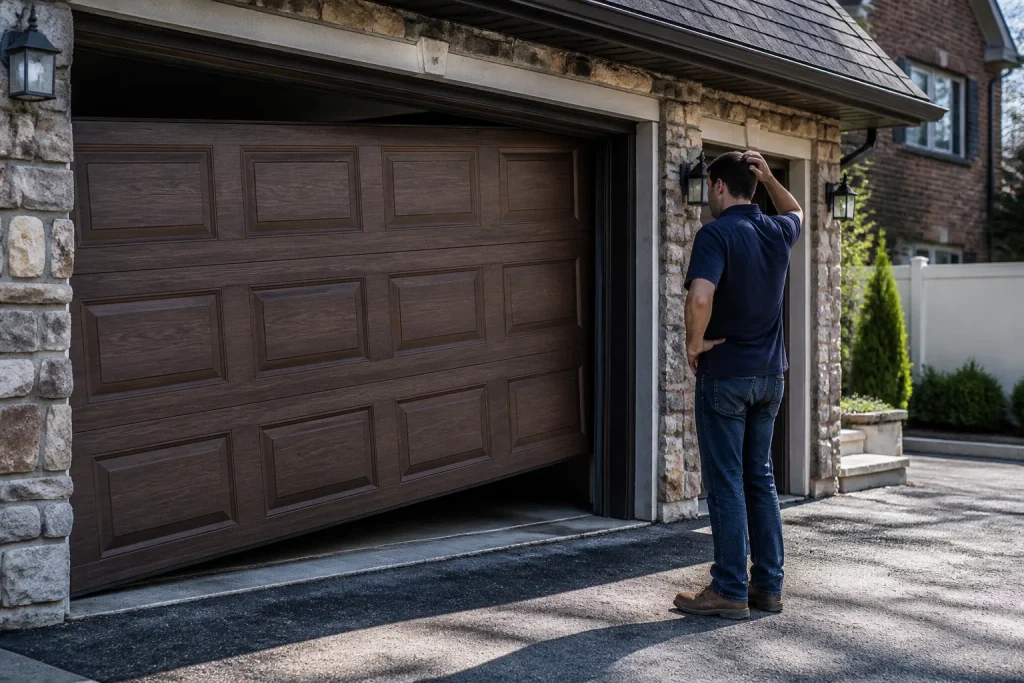
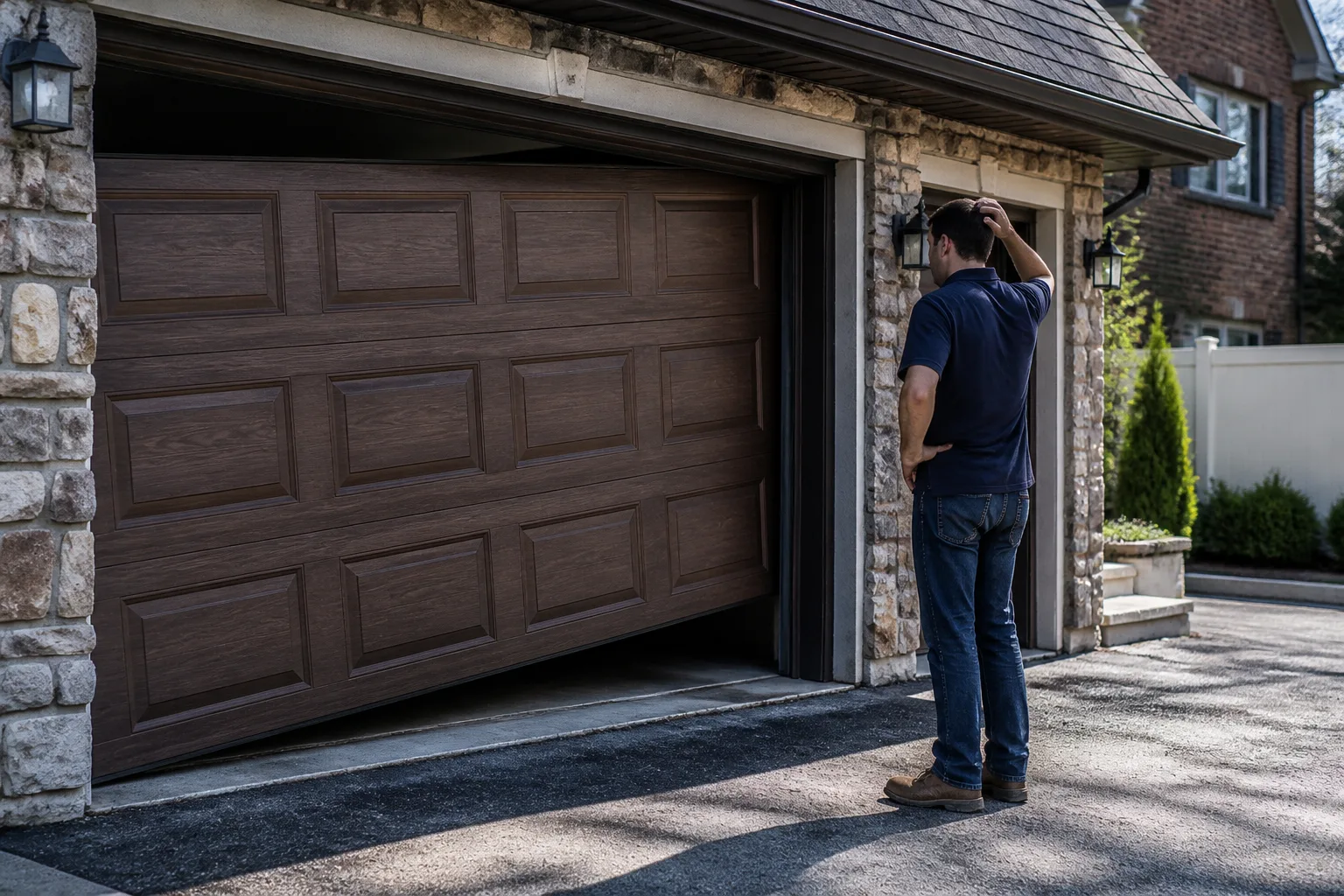
Top Signs You Need Garage Door Service – Don’t Ignore These
A garage door that takes two seconds longer to close than it did six months ago isn’t just slow. It’s a door whose spring tension has degraded, and it’s telling you something specific. The homeowners we talk to in Yonkers most often miss the early warnings and call only when the door stops dead. That turns a small repair into an emergency. Here are the signals worth reading early, what each one points to, and when to stop guessing and get a professional eye on it. If you’d rather not climb a ladder and diagnose it yourself, call (844) 443-4494 and we’ll take a look.
Why Your Garage Door Tells You Before It Breaks
Every garage door is a balancing act. Torsion or extension springs carry most of the door’s weight, cables and drums manage the lift, rollers travel the track, and the opener supplies the push. When one part starts to lose tension or wear, the others compensate. That compensation is what you hear and see. A heavy door drags; a loose cable rides crooked; a worn roller squeals. The trick is that these small adjustments build slowly, so it’s easy to write them off as “it’s always been a little loud.” Learn what normal sounds like, and anything new stands out immediately.
We work on the actual hardware already in your garage – Genie, Clopay, Amarr, Wayne Dalton and the rest of the major brands – so a trained technician can identify the component behind a symptom fast instead of guessing. Our technicians have up to 13 years of experience reading exactly these signals. The list below is what they listen and look for.
Sign 1: Grinding, Squealing, or Popping – Match the Sound to the Part
Each sound points to a different component, and that matters because the fix and the risk differ. Grinding usually means metal-on-metal contact, often a roller that’s seized or a track that’s out of alignment. Squealing tends to come from dry or worn rollers and hinges. Popping is the one to take seriously: a sharp pop, especially on a door that still moves, can signal a spring under failing tension or a cable that’s jumped its drum.
- Grinding: seized roller, bent track, or a drum binding on its shaft. Keep the door down and have it inspected.
- Squealing: worn rollers or hinges lacking lubrication. Often a straightforward repair if caught early.
- Popping or snapping: spring or cable trouble. Stop using the door. Springs and cables are under extreme tension and should only be handled by a trained technician.
- Rattling: loose bolts or brackets, sometimes a sign the whole assembly is working harder than it should.
We say this plainly because it’s the safety point that matters most: never try to adjust, cut, or remove a torsion or extension spring yourself. The stored energy in a loaded spring can cause serious injury in an instant. The safest move for a popping door in Yonkers is to leave it closed and get a technician out.
Sign 2: Uneven or Jerky Movement – and What Each One Means
Watch the door travel, not the opener. A door that rises crooked – one side ahead of the other – usually points to a stretched cable, a worn drum, or a track mounted out of level. A door that moves in fits and starts, jerking upward, often points to rollers binding in the track or a spring that’s no longer balanced side to side. Both wear the opener motor prematurely, because the motor is now lifting more than its share.
The structural signal is sagging at the center of a sectional door. That usually means a panel or the reinforcing strut has lost support, or a hinge is failing. A sagging door can bind the whole system and, if ignored, crack panels. From the floor you can safely note whether the door hangs level when closed, whether the gap under the door is even, and whether any panel looks bowed. That’s observation, not repair – and it’s enough to tell a technician where to start. For a closer look or a repair quote, this is a job for garage door repair before the sag turns into a panel replacement.
Sign 3: The Balance Test – Check Spring Health in 30 Seconds
This is the most useful check a Yonkers homeowner can do, and it doesn’t involve touching a spring. With the door closed and the opener disconnected (most openers have a pull rope for this – pull it so the door is in manual mode), lift the door by hand about halfway and let go gently. A properly balanced door should stay roughly where you left it, or drift very slowly. If it slams down or drops fast, the spring has lost tension and is no longer carrying the door’s weight. If it flies up, the spring is over-tensioned.
Reconnect the opener before you use the door again, and if the door fails the test, treat it as a signal to call a pro, not to adjust anything. A door that won’t hold its position is one where the spring is doing too little or too much, and both stress the opener and the door itself. This same test explains a lot of “my opener seems weak” complaints – often the opener is fine and the spring behind it is the real problem. When a wall button or remote also stops responding cleanly, it’s worth a call for garage door opener repair, because the symptom can come from the opener head, the safety sensors, or the spring load it’s fighting.
Sign 4: Slow Response From a Wall Button vs. a Remote
A slow or dead wall button and a slow or dead remote are two different problems, and knowing which helps. If the wall button works but the remotes don’t, the opener itself is usually fine – you’re looking at remote batteries, the remote’s programming, or a logic board issue on the receiving side. If the remotes work but the wall button doesn’t, the problem is more likely in the wall wiring or the button’s connection to the opener. If both are sluggish, pay attention to whether the door also hesitates when it starts moving: that points back to the door’s mechanical load, not the electronics.
Smart-home setups add another layer. LiftMaster and Chamberlain/myQ systems, and legacy Craftsman or Genie openers, each have their own way of reporting a fault through blinking lights or error codes. Our technicians are familiar with all of them, so a diagnosis doesn’t stall on “what brand is this again.” Before you replace an opener, get it diagnosed – sometimes the fix is a sensor alignment or a worn gear, not a whole new unit.
Sign 5: What to Inspect From the Floor (and What to Leave Alone)
You can spot a lot from ground level without putting your hands near anything under tension. Take a look a few times a year, especially after a stretch of cold nights, which tighten cables and stiffen lubricant. Here’s a safe visual checklist:
- Cables: look for fraying, kinks, or a cable that’s come off the drum. Frayed cables can snap – don’t touch, just note it.
- Rollers: check for flat spots, cracks, or rollers sitting loose in the track.
- Bottom brackets: the hardware at the door’s bottom corners carries cable tension. Never loosen or adjust these – have a technician handle them.
- Track: dents, gaps between sections, or a track that’s pulled away from the wall.
- Weather seal: a torn bottom seal lets in drafts and water and can cause the door to bind unevenly.
This is also where a new door becomes worth considering. If a Clopay, Amarr, or Wayne Dalton door has cracked panels, repeated cable failures, or a bent track that keeps coming back, the repair math can tip toward replacement. That’s a decision to make with a written quote in hand, not on the spot. When you’re weighing it, garage door installation is where a specialist can lay out the options honestly.
Deferred Maintenance vs. Emergency Repair: The Real Cost of Waiting
This is the part homeowners in Yonkers ask about most. Waiting on a known issue doesn’t save money – it usually moves the cost from maintenance into emergency territory. A worn roller replaced early is a small job. Left alone, it can wear the track, strain the opener, and turn into a larger repair. A spring that’s failing can eventually snap and leave the door stuck, sometimes with a car trapped inside.
We won’t quote you a number we haven’t verified, because the price is set per job by a written estimate after we see the door. What we can tell you is the pattern: the longer a fixable signal goes unaddressed, the more parts it takes down with it. The dollar gap between a small maintenance repair and a same-day emergency call is real, and it widens the longer you defer.
When to call a pro: any popping or snapping from the springs, a door that fails the balance test, a frayed cable, a door that rises crooked, or a bottom bracket that looks loose. Those are the ones where DIY stops being worth it. Garage doors are all we do, so a technician diagnoses correctly and fixes it the first time, from spring to opener to the full door. If you’re in Yonkers and need help, Yonkers Garage Door Repair Co offers free estimates – call (844) 443-4494.
Related services in Yonkers: for spring work, opener trouble, or a full door replacement, the fastest path is a call – our team will route you to the right service and set up a free estimate.
The Bottom Line
Your garage door warns you before it quits. Grinding, squealing, and popping each point to a different part. Uneven and jerky movement tell you whether the trouble is the cable or the balance. The 30-second balance test is the simplest way to check spring health without touching anything dangerous. Wall-button vs. remote behavior separates electrical faults from mechanical ones. And waiting on a known issue almost always costs more than fixing it early. If you’re in Yonkers and need help, Yonkers Garage Door Repair Co offers free estimates – call (844) 443-4494. We answer 24/7, with fast dispatch from 7am to 7pm, Sunday through Friday.
Frequently Asked Questions
The earliest signs are usually sound and speed changes: a door that grinds, squeals, or takes longer to close than it used to. Uneven movement and a door that fails a quick balance test are close behind. Call (844) 443-4494 for a free estimate if you notice any of them.
If the door is heavy in manual mode or fails the balance test, the problem is the spring, not the opener. If the door moves smoothly by hand but the opener hesitates, the opener or its sensors are the likely cause. A trained technician confirms it in minutes – call (844) 443-4494 to book a look.
Light squealing from rollers can usually wait a short while, but popping, snapping, or a crooked door should not be used. Springs and cables are under extreme tension and can cause serious injury. Leave the door down and call (844) 443-4494.
No. It often points to a worn roller, a dry hinge, or a spring losing tension – repairs that are far smaller than a full replacement if caught early. The written estimate sets the price before any work starts. Call (844) 443-4494 for a free estimate.
Written by the team at Yonkers Garage Door Repair Co.
Need Garage Door Help?
Call Yonkers Garage Door Repair Co - the local pro we connect you with is licensed and insured, here with fast help in Yonkers.
(844) 443-4494