
Garage Door Repair: Repair or Replace? How Yonkers Homeowners Decide
Most homeowners ask the wrong question first. They look at the install sticker in the corner of the door, see a number they don’t love, and decide age is the verdict. Age rarely is. Plenty of doors over fifteen years old are perfectly sound; plenty under ten are on borrowed time. The real decision comes down to three things: structural integrity, parts availability, and whether the repair bills are climbing. That’s what we’ll walk through here, so you can make the call with facts instead of guesswork. If reading this makes you want eyes on the actual door, call (844) 443-4494.
The Three Factors That Actually Drive the Decision
When we diagnose a door in Yonkers, we’re not deciding based on years on a sticker. We’re weighing three variables that behave differently in every garage. Get them clear and the answer usually becomes obvious.
1. Structural integrity. Is the door frame, track and panel system still capable of sealing and rolling safely? A door that doesn’t sit flush, won’t seal against the weather, or racks in its tracks is a different problem from a door with a scuff.
2. Parts availability. Can the specific brand and model still be serviced? A Wayne Dalton or Amarr panel that’s discontinued changes the math. A door with a healthy supply of compatible hardware keeps its options open.
3. Cumulative repair cost. Are you spending a little every season, or one clean repair? Repairing a door is smart money until the running totals start adding up to what replacement would cost.
Those three factors interact. A door with strong structure but discontinued hardware may still be a repair candidate because the panel and frame are worth saving. A structurally compromised door with a healthy parts supply is still a replacement conversation. Age is the one variable that tells you the least, which is why we put it last.
Structural Integrity: Cosmetic Damage vs. Damage That Matters
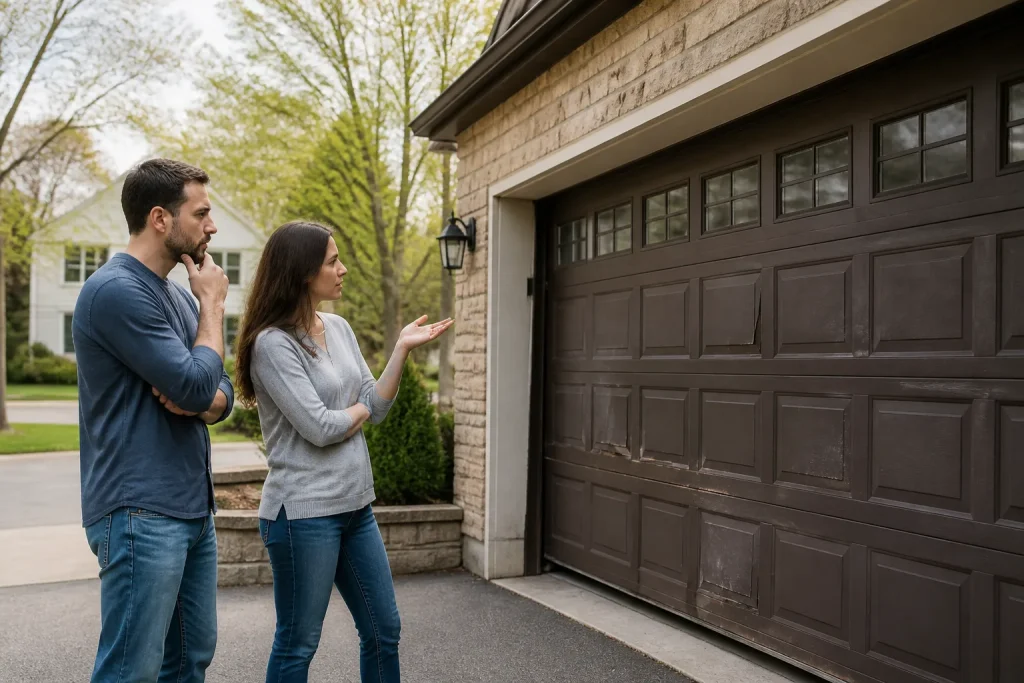
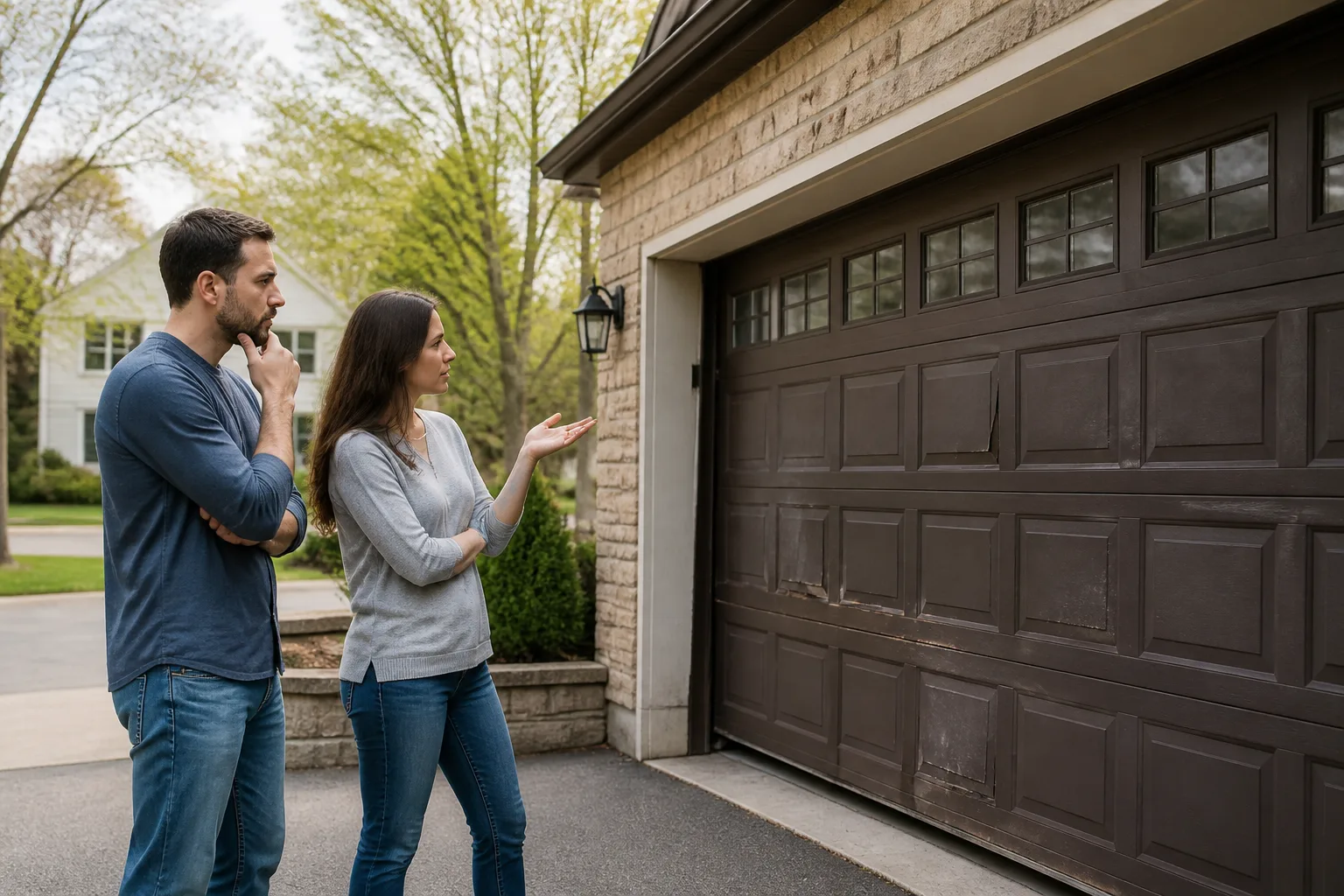
A dented panel is often just a dented panel. Cosmetic damage changes appearance; structural damage goes to a door’s ability to seal out weather and move safely. In our experience around Yonkers, the distinction homeowners miss most is between what shows and what performs.
Cosmetic-only damage typically looks like this:
- Shallow dents or scuffs in a panel that doesn’t affect the door’s alignment
- A single dented section window or a bent handle
- Faded paint or worn finish
Damage worth taking seriously usually looks like this:
- Panels that are bent, buckling or separating from the frame
- Gaps at the bottom or sides when the door is closed (a seal failure)
- Visible warping or a door that sits unevenly in its opening
- Tracks that are bent, misaligned or pulling away from the frame
A door that no longer seals is doing real damage – to your energy bill, to your floor and to the way the door moves on its tracks. If you’re seeing flexing in a panel or hearing a door that rumbles, that’s more than cosmetic. A technician can tell the difference quickly, and a trained eye is worth it here: the spring and cable system is under real tension, and handling it wrong can be genuinely dangerous. Call (844) 443-4494 if you’re unsure where your door falls.
The Parts Availability Reality for Older Doors
Parts availability is the factor most homeowners never think about, and in Yonkers it’s frequently what tips the decision. Brand matters more than age. Doors built by Amarr, Wayne Dalton or Raynor still in production are generally easier to service, while a discontinued model can leave you hunting for hardware that no longer exists.
When a panel or key component is discontinued, the repair is still possible – it just means we’re matching a new part to old hardware, which raises the chance the door goes out of alignment and creates a second repair. A door in that situation often makes more sense to replace than to keep patching. A door with a healthy supply is the opposite story: a Frank door-adjacent situation would be simpler if it existed in your garage, but for now, check the brand and model number on the door’s label before you assume replacement. A Craftsman opener with a healthy door and a straightforward brand means repair stays on the table.
This is also where the phrase “we work on the brand already in your garage” earns its keep. When your brand falls inside the ones we carry expertise on, the parts conversation gets much clearer. The label inside your garage is usually the most useful clue on the door.
The Cumulative Repair Cost Framework: When the Math Gets Obvious
This is the test most homeowners skip, and it’s the one that makes the decision feel clear. Take a piece of paper and sketch out the last two years of repair spending. If you’re doing one repair every season, you’ve crossed the threshold.
- Track every repair. A routine repair, a spring replacement, a cable fix, a diagnostic call – write each one down with its date.
- Add them up over 24 months. That running total is the number that matters. A little here, a little there adds up fast.
- Compare to replacement. When the running total is closing the gap on the price of a new door, the next repair usually tips it. You’re now paying to keep a door that’s telling you it’s done.
- Factor in future risk. A door in the third repair in two years is likely one or two repairs away from a fourth, and springs and cables wear in sequence.
The framework isn’t meant to push anybody to replace. It’s meant to show you the number you might otherwise never add up. If your total is low and the repair is one-off, keep the door. If your total is climbing and the pitch is still going the same way, replacement math is the honest arithmetic.
So when someone calls about garage door repair and a door that’s been repaired two or three times, we walk them through exactly this sum before we recommend anything.
What Replacement Actually Involves in a Yonkers Attached Garage
Most Yonkers homes have an attached garage where the door is a structural player in the house, which changes the process relative to a detached build. Replacement starts with a professional measurement – not a guess from a tape measure in the driveway. Then the door is ordered, scheduled, and installed with the existing opener and hardware assessed along the way.
Two practical things to know:
- Permits. Most cities require a permit for this kind of work, so ask your city’s building department what applies to your project before work is scheduled. The permit rules vary by municipality and are worth confirming early.
- The opener and hardware. A new door doesn’t mean a new opener, and vice versa. A LiftMaster or Chamberlain opener paired with the right hardware often carries over; a legacy Craftsman or Genie system may still work, or may be the next thing to upgrade. We work with the brand already in your garage, so the conversation stays grounded in what you actually have.
Replacement is scheduled work – a measured, ordered and installed job, not a same-day call. That timing matters more than the door’s age when you’re deciding, because it’s the part you’ll actually feel.
When a Repair Makes More Sense Than a Replacement
The daily mechanics of your door usually answer this better than any list. A door that was working fine yesterday and stopped today is usually a repair call, not a replacement conversation. A snapped torsion or extension spring, a failed cable, a dead opener on a structurally sound door – all of those are repair territory, and the door is worth saving.
These are the situations where we lean repair:
- The door moves well, seals properly, and shows no warping
- The failed part is a spring, cable or opener on an otherwise healthy door
- The brand and model still have serviceable parts available
- The repair is one-off, not a recurring pattern
The spring and cable work in particular is the most hazardous part of any garage door repair. A door under tension is not something to tackle with a YouTube video and an afternoon. We keep spring work as a named specialty for exactly that reason, and we’d rather diagnose it well than rush it. When your door won’t move, we will. Call (844) 443-4494 and get a free estimate on the actual problem.
A failing opener is often its own repair decision, which is why we handle garage door opener repair as a separate assessment from the door itself. If the opener is the failure and the door is sound, that’s a repair. If the whole system – door, opener and hardware – is at the end of its run, that’s a different conversation.
When a Pro Should Make the Call for You
Some of this you can assess yourself: the seal, the label, the dates on your repair receipts. But there are moments when a professional diagnosis is worth it – not because we’re selling anything, but because the wrong call costs more than the right one later.
Call a technician if you notice any of these:
- A door that binds, grinds or racks in its tracks
- A spring that’s visibly broken or a door that won’t open under its own weight
- A door that won’t stay closed or doesn’t seal evenly across the opening
- A door that’s been repaired repeatedly with rising costs
Each of those is a sign that the structural or mechanical picture needs eyes on it, not just an opinion from the driveway. Our technicians have up to 13 years of experience, and garage doors are all we do – which is why we can tell you repair versus replace quickly and back it up with a written estimate. If the door is a projected replacement, garage door installation is scheduled after a measure, with the price agreed in writing before any work starts.
Related services in Yonkers: spring replacement, opener repair and full door installation. You can read more about our work at Yonkers Garage Door Repair Co.
The Bottom Line
The repair-or-replace question in Yonkers comes down to structure, parts and cost trend, not the age on the sticker. A door with sound structure and available parts is usually worth repairing; a door with structural damage and a rising repair total is usually worth replacing. If your running repair total over 24 months is closing in on the price of a new door, the next fix usually tips it. If the door is one missed service and a healthy brand, keep it. If you’re in Yonkers and need help sorting out which side of that line your door is on, Yonkers Garage Door Repair Co offers free estimates – call (844) 443-4494. We answer 24/7, and fast dispatch runs from 7am to 7pm, Sunday through Friday. The written estimate sets the price before any work begins.
Frequently Asked Questions
Repair usually wins when the door’s frame and panels are sound, the parts are still available, and the repair is a one-off. Replace when the door has structural damage, the brand’s hardware is discontinued, or your repair costs over the last two years have climbed toward the price of a new door. Age alone is not the deciding factor.
Replacement makes sense when the running total of repairs over 24 months approaches the cost of a new door, when structural damage affects sealing or movement, or when a discontinued model has no compatible parts. If the door is still sealing and the failure is one part, repair is usually the smarter call.
Replacement is scheduled, not same-day – it involves a professional measure, ordering the door and installation. Check with Yonkers’s building department about permit requirements for your project, since those vary by municipality and affect the timeline.
Most cities require a permit for garage door work, so confirm with the Yonkers building department before the job is scheduled. The permit rules and process are set by the municipality, and it’s worth checking early in your planning.
No. We quote the job and agree the price before any work starts, so the written estimate is what you pay. Call (844) 443-4494 for an exact quote – estimates are free.
Written by the team at Yonkers Garage Door Repair Co.
Need Garage Door Help?
Call Yonkers Garage Door Repair Co - the local pro we connect you with is licensed and insured, here with fast help in Yonkers.
(844) 443-4494